
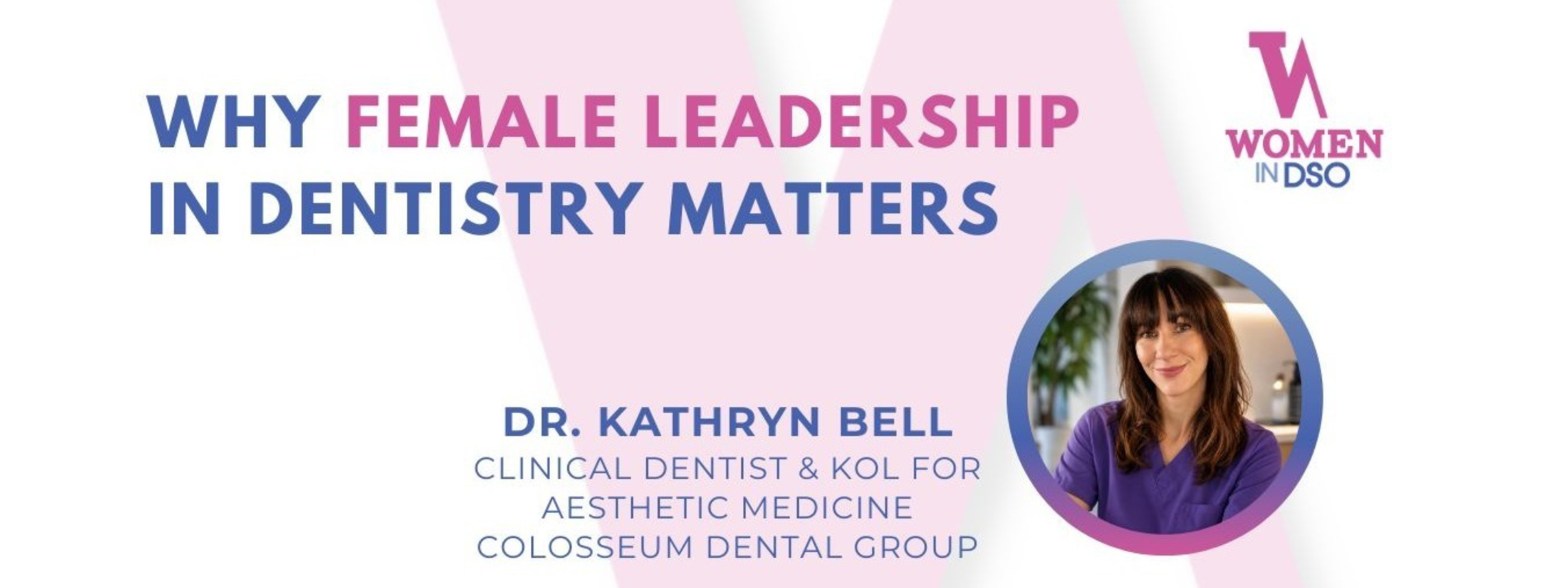
Why Female Leadership in Dentistry Matters
I graduated from Leeds Dental Institute in 2005, fresh-faced and certain I knew exactly what my career would look like: I would be a clinician. I would treat patients, hone my skills, and build a reputation chairside. For a long time, that was enough — and it was a privilege to do work I loved.
Then in 2015, I took my first steps into aesthetics, and something shifted. What started as an additional skillset became a genuine passion, and alongside it came an appetite for something I hadn't anticipated: growth that extended beyond clinical excellence. I spent years studying, attending courses, reading, reflecting, and quietly building confidence in a part of myself I hadn't yet had the chance to use professionally. Last year, that work was recognised when I was offered a leadership position to help grow the aesthetics side of the business alongside my clinical work. I didn't step out of the surgery to take it. I stepped into something new while keeping a foot firmly planted in the work that started it all.
I share this not because it's a remarkable story, but because it's a familiar one, and I think familiarity is exactly the point. So many women in dentistry have spent years quietly developing skills, knowledge, and instincts that have nothing to do with a job title and everything to do with readiness. The opportunity to lead doesn't always arrive with fanfare. Sometimes it arrives because someone notices the work you've already been doing, often invisibly, for years.
The People Who Showed Me What Was Possible
I don't think anyone reaches a leadership role on their own steam alone, and I certainly haven't. Two women, in particular, have shaped how I think about ambition, capability, and what's possible.
The first is Farzeela, our CMO. Anyone who has worked alongside her will tell you the same thing: she has a kind of energy that seems to multiply rather than deplete the more she gives. Her "can-do" attitude isn't a performance — it's simply how she approaches every problem, every setback, every opportunity. Watching her work has taught me that leadership isn't about having all the answers; it's about bringing relentless effort and genuine belief to the table, even when — especially when — the path forward isn't obvious. Her work ethic has quietly reset my own expectations of what's achievable.
The second is my mum. She became a mother in her late teens, which in many respects could have closed doors before she'd had the chance to open them. Instead, in her late twenties, she went back to university, earned her degree, and went on to take up a leadership position within library services. I grew up watching a woman rebuild her own trajectory from a starting point that society often treats as a limitation rather than simply a circumstance. She never made a big speech about resilience or ambition. She just got on and did it. I think that's the version of leadership that has influenced me most: not the loudest in the room, but the most determined.
Between Farzeela's energy and my mum's quiet persistence, I've come to understand that there isn't one template for a female leader. There's only the willingness to keep going, keep learning, and keep showing up for the next opportunity, however it presents itself.
A Profession Built by Women, Led by Too Few of Them
Here's something that sits uncomfortably with me, and I suspect with many women reading this: dentistry, at the clinical level, is overwhelmingly female. Walk into most dental schools or associate meetings today and you'll see rooms full of brilliant, hardworking women. Yet walk into the boardrooms of DSOs, the ownership structures, the C-suite — and that representation thins out dramatically. We are treating patients in huge numbers, but we are not, proportionately, the ones deciding how those businesses are run, where they invest, or what their future looks like.
This isn't a criticism of the industry so much as it is an honest observation of where the work still needs to happen. Clinical excellence and business leadership require different, complementary skillsets, and there's no reason the same women filling our clinics shouldn't also be filling our leadership pipelines, our partner tracks, and our ownership rosters. The talent is there. What's needed is the structural belief that this talent belongs in those rooms too — and a willingness from those of us already finding our way in to hold the door open behind us.
This is why representation at the top matters so much, beyond any individual career story. When women see other women holding equity, running businesses, sitting on leadership boards, it does something practical: it makes the entire ladder visible. It tells a junior clinician, three years into associate life, that leadership isn't a parallel universe reserved for someone else — it's an extension of the same ambition that got her through dental school in the first place. Representation at the top isn't symbolic. It's empowering, in a very literal sense, for every woman further down the chain who is quietly wondering whether this path is open to her.
What I Hope for the Future
I don't think the future of women in dentistry looks like a dramatic overhaul. I think it looks like steady, deliberate change: more women being offered leadership roles the way I was, more mentorship that treats ambition beyond the chair as something to be nurtured rather than incidental, and more DSOs actively building pathways from clinical practice into ownership and strategic leadership.
I didn't leave clinical dentistry to find this opportunity — I found it by continuing to grow within it. That, I think, is the real message: leadership doesn't have to mean choosing between the surgery and the boardroom. For so many of us, it can mean building both, side by side, and bringing other women along as we go.
About the Author
Dr Kathryn Bell is a dentist and aesthetic practitioner with over 20 years of experience across NHS, private dentistry, and aesthetic medicine. She graduated with honours from Leeds Dental Institute and is currently completing a Master’s degree in Aesthetic Medicine at Queen Mary University of London.
Alongside her clinical work, Kathryn is developing her role as a Key Opinion Leader within Colosseum Dental Group, contributing to education, mentoring, and the evolution of aesthetic services within a large corporate setting. She is particularly passionate about supporting other clinicians—especially women—who are navigating career transitions, building confidence, and redefining what leadership can look like in modern dentistry.